
Why Biodiverse Gardens Are Political: Foodscaping as Resistance
The moment you plant a tomato instead of turfgrass, you've made a political choice. When you choose native milkweed over exotic ornamentals, when you let your dandelions bloom for the bees, when you save rainwater in cisterns instead of letting it rush into storm drains—these aren't just gardening decisions. They're declarations of values that run counter to the dominant extractive, consumptive culture we're steeped in.
Permaculture as Resistance
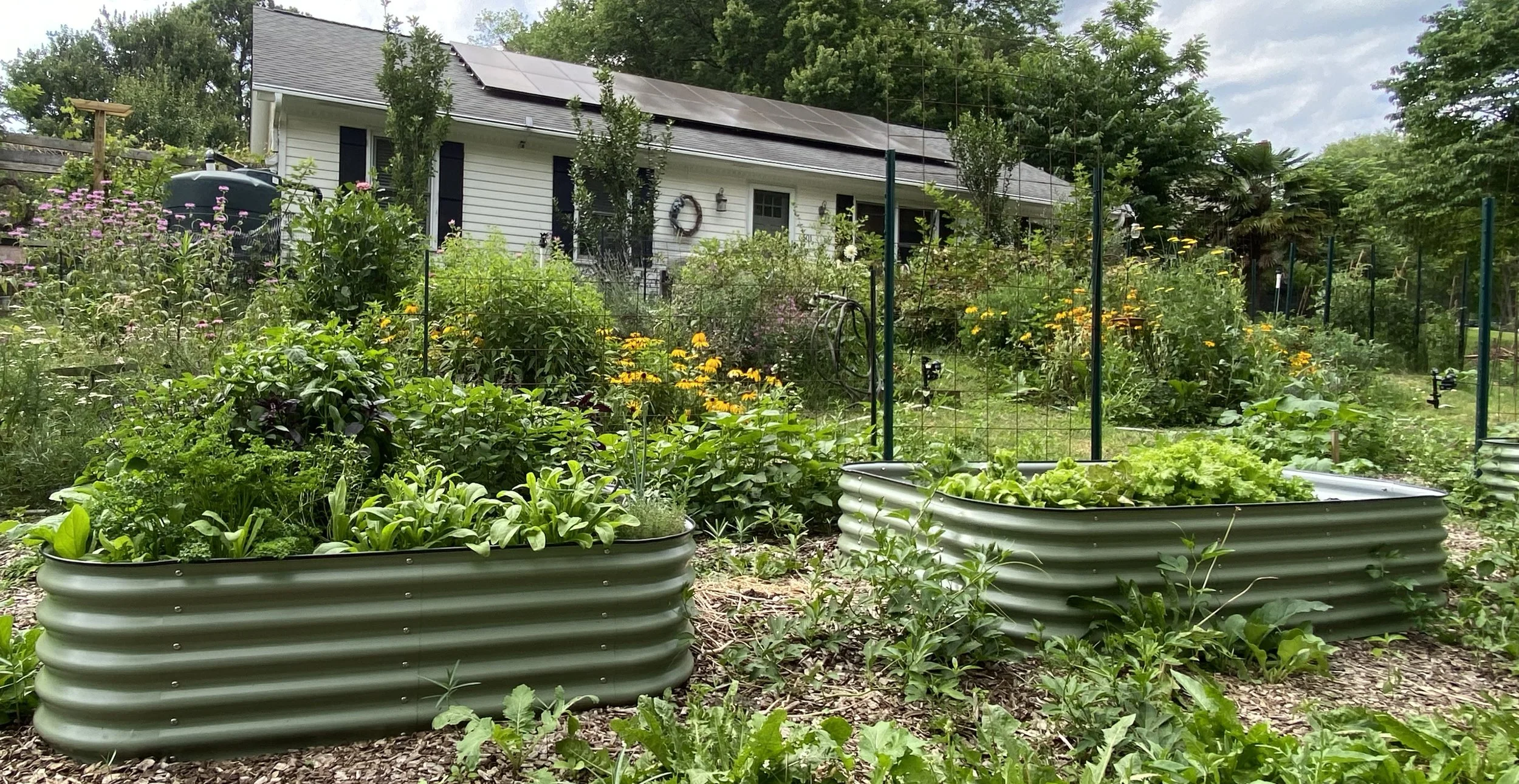
Permaculture's three core ethics—care for the earth, care for people, and redistribution of surplus—read like a manifesto against everything the current political regime represents. These principles ask us to work with nature rather than against it, to prioritize community well-being over individual accumulation, and to share abundance rather than hoard it. In a political landscape dominated by extraction, exploitation, and the concentration of resources, choosing to garden in accordance with these ethics is inherently oppositional.
We're asked to live in harmony with what the land offers us, rather than demanding that the land bend to our will. This is antithetical to an economic system built on endless growth and resource extraction. It's a quiet but profound rejection of the idea that nature exists solely for human profit.
“To plant a garden is to believe in tomorrow. ”
Reclaiming Food, Reclaiming Power
Growing food and gardening are fighting a system that deliberately limits who has access to fresh, healthy food. When you garden, you're challenging industrial agriculture's stranglehold on our food supply. You're confronting the reality of food deserts. You're refusing to accept that corporations should control what we eat and who gets to eat well.
This is why gardening is radical: it goes beyond a hobby to become a political act. You're fostering community resilience and reclaiming power over food. You're promoting social and environmental justice by growing food locally, sharing resources, and transforming neglected spaces into productive, empowering gardens. It's about using the simple act of cultivating food to build independence, equity, and connection.
You're reclaiming land for people, not profit. Every tomato plant is a small act of defiance against a food system designed to keep people dependent, unhealthy, and disconnected from the source of their sustenance.
Our Suburban Rebellion
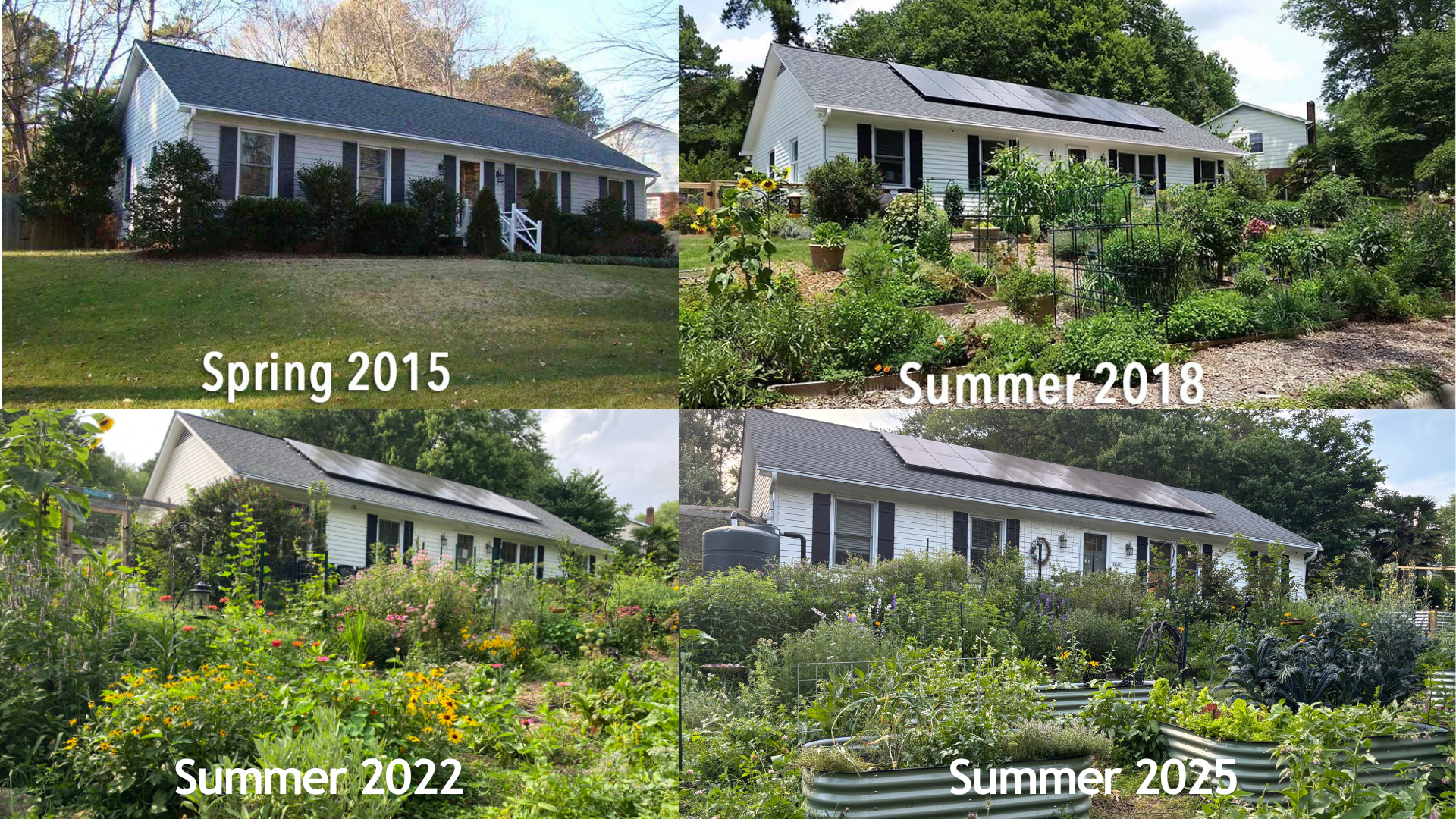
When we bought our home in 2015, we inherited what most American suburbs consider the ideal: trees, grass, and a prominent slope. Nothing too wild, nothing too productive, nothing that might upset the neighbors. But we had different plans.
We've spent a decade transforming every square inch. We built the soil with constant applications of tree mulch—hello ChipDrop, my old friend. We took down trees in the front yard where the sun was, not out of destruction but out of strategy, so we could grow food and install solar panels. Those trees were replaced with fruit trees, native species, and productive shrubs. We slowly reshaped the slope of our land. We gardened on every available surface. Just as we use every part of our small home with intention, we use every part of our property with intention.
It's an evolving project. Each year, we learn from our experiences, adjust, adapt, and expand our understanding of what this land can support.
“I like gardening. It’s a place where I find myself when I need to lose myself.”
The Audacity of Visible Food Production
This type of front-yard, in-your-face garden isn't what's expected in the city limits of Raleigh, especially not in a very suburban cul-de-sac. If there were an HOA, we couldn't have done any of this—which is exactly why not having an HOA was a non-negotiable priority when we bought the house.
We added two 500-gallon cisterns to collect rainwater, plus various 50-gallon rain barrels scattered around the property. We keep a flock of chickens on the side of our house, visible from the sidewalk behind their fence. Do some people hate what we're doing and think our yard is an eyesore? Absolutely. But most love it, and others really like my husband and me, so they don't mind it—or at least don't say anything to us. Not that it would matter if they did.
The divide in reception is telling. Young people—millennials and younger, and many fellow Gen Xers—plus anyone born and raised in another country, almost universally love what we're doing. In Europe, my yard would be pretty common. The younger generations are waking up to the reality that a monoculture lawn is one of the worst things for the environment. People make a point of coming down our dead-end block just to walk by and see what's growing.

Building Community Through Food
The chickens have become neighborhood celebrities. People come over with their kids and grandkids specifically to see the flock, and we show them what's growing in the garden that they can feed to the birds. It becomes an impromptu lesson in what chickens eat, what plants are edible, and how a garden ecosystem works.
We completely foodscaped our hellstrip—that awkward strip of land between the sidewalk and street that most people ignore or fill with struggling grass. Ours is planted with herbs that our neighbors are welcome to harvest. We regularly share our produce with neighbors. This isn't just about growing food for ourselves; it's about creating abundance that ripples outward.
This is what permaculture's "redistribution of surplus" looks like in practice. Not abstract theory, but tomatoes handed over the fence, herbs snipped by passersby, kids learning that food comes from soil and not just stores.
“If you have a garden and a library, you have everything you need. ”
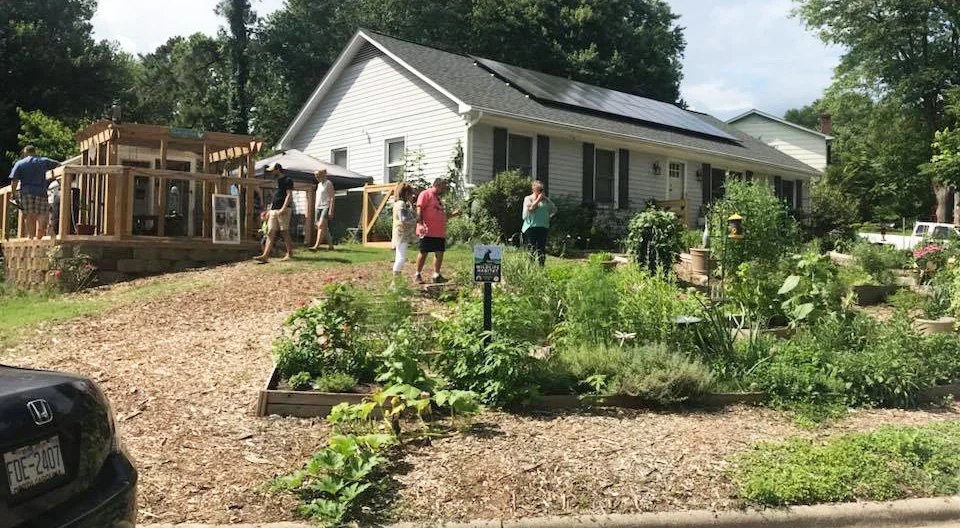
Tour D’Coop 2018 - Sharing our garden and chicken keeping set up
“When an economic system actively destroys what we love, isn’t it time for a different system?”
Radical or Necessary?
What we're doing is deemed radical, and maybe it is—for American suburbia. But it's also a necessity for people who want to know where their food comes from, who want to live more sustainably and shrink their carbon footprint, who refuse to participate in the chemical-intensive, resource-depleting lawn industrial complex.
Our yard is so biodiverse that there's life everywhere, year-round. Dragonflies are attracted to our small pond. Butterflies, hover flies, and hawk moths feed on night-scented tobacco plants. Toads, tree frogs, and frogs in the pond. Anoles darting through the undergrowth. Rabbits, moles, countless insects, and pollinators. It's alive. It's diverse. It's thriving.
And apparently, that's political. That's leftist. That's radical.
And that's perfectly fine with me.
Because if choosing life over sterility, diversity over monoculture, and abundance over scarcity is radical, then radicalism is exactly what we need. Every seed we plant is a small act of defiance. Every native plant we nurture is a vote for a different kind of future. Every chicken that scratches in our yard, every tomato we harvest, every drop of rainwater we capture—these are all quiet refusals to accept the status quo.
Your garden is political whether you intend it to be or not. What matters is whether you're willing to let it speak.
Want to build your own foodscape? Reach out. I'm here to help you transform your yard into a place alive with abundance. Contact me or DM @ralsteadfoodscapes. Let's build the food systems we need, one garden at a time.